

Overview
Flow Analysis tests complete user journeys to identify missing paths, states, and friction points. Analyze static flows for edge cases or test interactive prototypes with real user tasks. Time per analysis: ~2-3 minutesCost: 75 credits per analysis
Frames: 1-6 for missing states, 2-6 for flow testing
Two Features
Choose how you want to analyze your flow:Missing States
Analyze static screens for missing states and edge cases.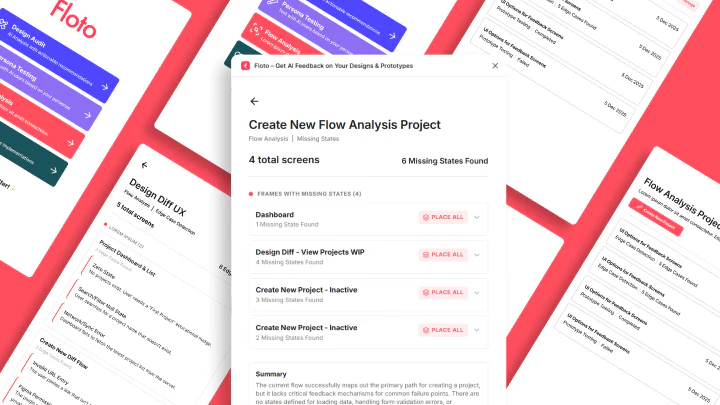
- Missing states and scenarios
- Incomplete edge cases
- Gaps in user journey
- State transitions that are missing
Flow Testing
Test interactive prototypes to see how users navigate.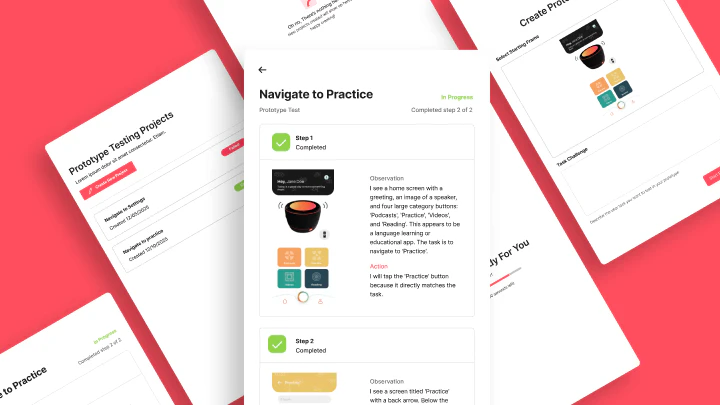
- How users move through your prototype
- Where they get stuck or hesitate
- Where they’d drop off
- Unclear navigation paths
How It Works
Step 1: Open Flow Analysis
Click Flow Analysis in the Floto plugin.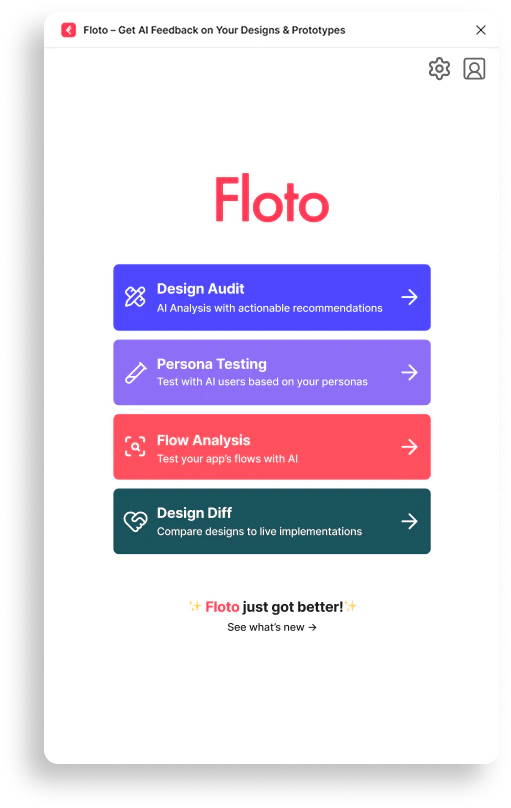
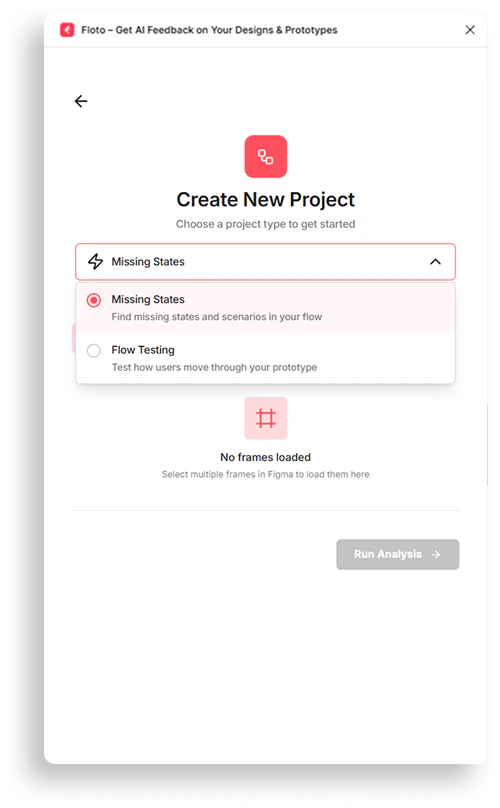
Step 2: Choose Analysis Type
Select one of two types:- Missing States - Find missing states and incomplete scenarios
- Flow Testing - Test how users move through your prototype
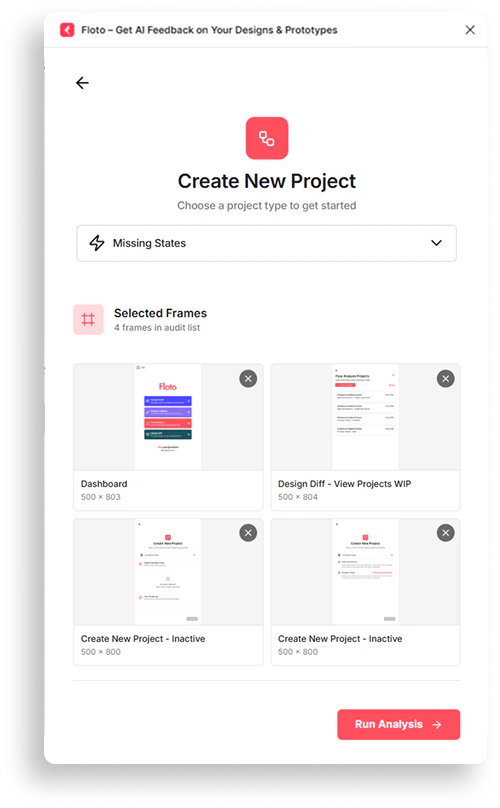
Step 3: Select Frames
For Missing States:- Select 1-6 frames representing your flow
- Can be screens, wireframes, mockups, or components
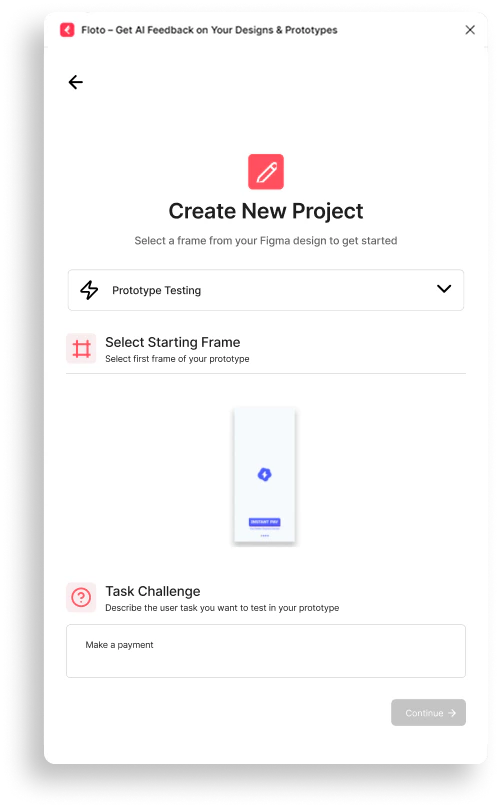
- Select a start frame
- Figma prototype must be connected to that frame (prototype connections required)
- Define what users should accomplish:
- “Sign up for an account”
- “Complete checkout”
- “Find pricing and select a plan”
- “Reset a forgotten password”
Step 4: Review Results
For Missing States: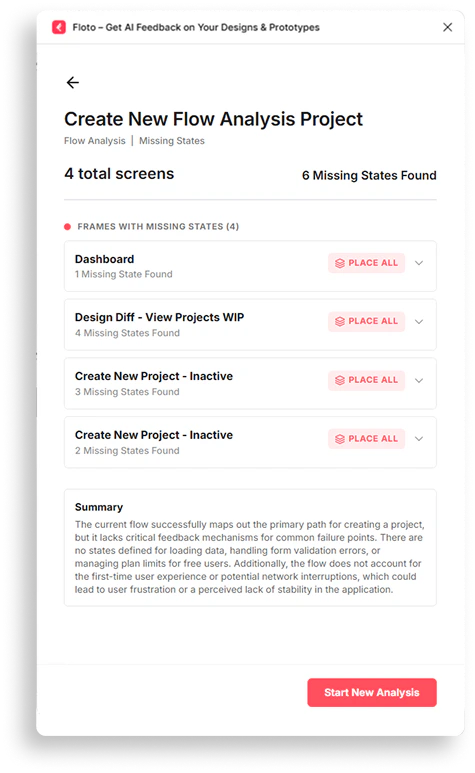
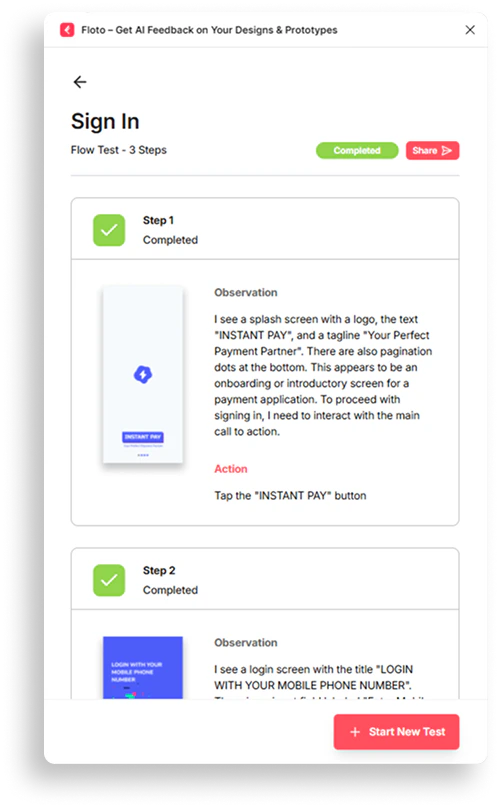
Understanding Results
Missing States Report
For each gap identified:- State - What’s missing
- Context - Where in the flow it’s missing
- Impact - Why it matters for user experience
- Fix - How to add the missing state
Flow Test Report
See how users navigate:- Path taken - Which screens the AI visited
- Task completion - Did they achieve the goal?
- Friction points - Where they hesitated
- Unclear interactions - Buttons/paths that confused them
- Drop-off points - Where they got stuck
Frame Requirements
Supported Frames
- Figma frames, screens, components
- Wireframes and mockups
- Interactive prototypes (for flow testing)
Frame Size
- No minimum size
- Maximum: 20MB per frame
- Recommended: 320px - 1920px width
Frame Selection
Missing States: 1-6 frames Flow Testing: 1 start frame- Figma prototype must be connected to that frame
- Prototype connections required in Figma (interactions set up)
FAQ
Which should I use, Missing States or Flow Testing?
Which should I use, Missing States or Flow Testing?
Missing States if you want to find incomplete states and edge cases in static designs. Flow Testing if you have an interactive prototype and want to see how users navigate to accomplish a task.
Do I need a fully interactive prototype for Flow Testing?
Do I need a fully interactive prototype for Flow Testing?
Yes. Frames should have logical navigation so users can move between them based on the task goal.
Can I test multiple flows?
Can I test multiple flows?
Yes. Run separate analyses for different user journeys (onboarding, checkout, account settings, etc.).
What if my frames aren't interactive?
What if my frames aren't interactive?
Use Missing States instead. It analyzes static screens without requiring navigation.
How many credits does an analysis cost?
How many credits does an analysis cost?
Each analysis costs 75 credits, whether Missing States or Flow Testing.
Can I see where exactly users get stuck?
Can I see where exactly users get stuck?
Yes. Flow Testing shows friction points, hesitations, and drop-off locations in your flow.
What if the flow test doesn't complete the task?
What if the flow test doesn't complete the task?
The report shows where the AI got stuck or dropped off. Review that step to fix the unclear navigation or missing interaction.
Next Steps
- Identify a critical user flow (signup, checkout, onboarding)
- Run Missing States analysis to find gaps
- Or test an interactive prototype with Flow Testing
- Review friction points and missing paths
- Update your design based on findings
- Retest to verify improvements